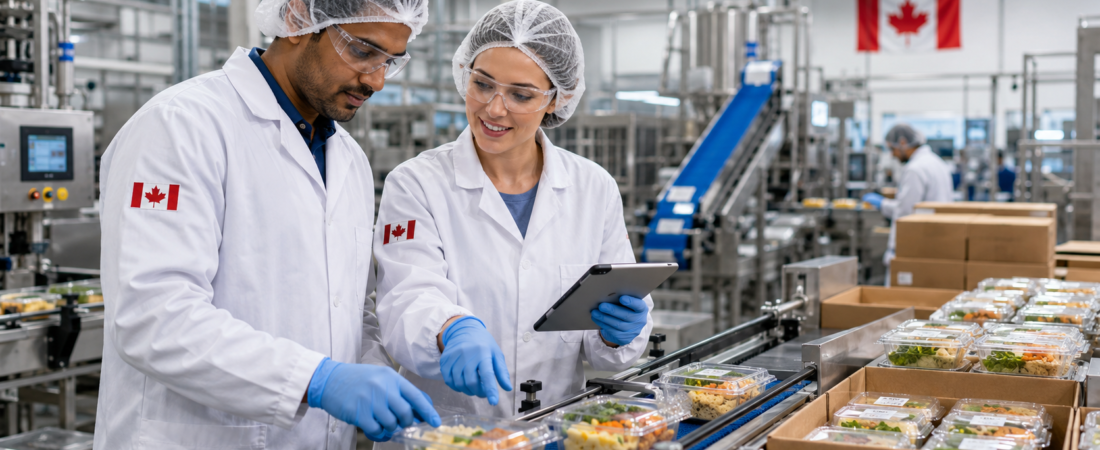
Canada’s food production and processing industry employs thousands of workers across factories, warehouses, meat-processing plants, bakeries, beverage companies, seafood facilities, dairy operations, and agricultural processing businesses. For foreigners hoping to work in Canada, food packaging jobs are among the employment opportunities worth exploring because many positions focus on practical factory duties rather than advanced professional qualifications.
Foreign workers can legally work in Canadian food-processing and packaging facilities when they have the appropriate immigration status or work permit. In situations where an employer cannot find enough Canadians or permanent residents to fill available positions, the employer can use Canada’s Temporary Foreign Worker Program, provided all applicable government requirements are satisfied.
For applicants outside Canada, the process normally begins by securing a genuine job offer. The employer then completes the required immigration and employment procedures, which can include obtaining a Labour Market Impact Assessment, commonly known as an LMIA. Once the employer provides the necessary documents, the foreign worker can proceed with the appropriate Canadian work-permit application.
This guide explains how food packaging jobs in Canada work, available positions, expected duties, salaries, visa sponsorship, qualifications, locations to consider, and how foreign applicants can improve their chances of securing legitimate employment.
What Are Food Packaging Jobs in Canada?
Food packaging workers are part of the workforce responsible for preparing food products for storage, distribution and sale.
The exact responsibilities depend on the company and the products manufactured at the facility. A worker employed at a bakery will perform different tasks from someone working in a seafood-processing facility, meat plant or beverage factory.
A typical food-processing facility receives raw materials, transforms or prepares them into finished products, performs quality checks, packages the products, labels them and prepares them for shipment to supermarkets, restaurants, distribution centres and other customers.
Packaging employees are therefore an important part of Canada’s food supply chain.
Some facilities rely heavily on automated packaging machinery, meaning workers monitor production lines, place products into containers and inspect finished packages. Other workplaces involve more manual responsibilities such as sorting, weighing, wrapping, boxing and preparing products for transportation.
Can Foreigners Get Food Packaging Jobs in Canada?
Foreign nationals can work in Canada’s food-processing industry as long as they have legal authorisation to work.
For applicants living outside Canada, one of the most common routes is an employer-specific work permit.
An employer-specific work permit allows a foreign worker to work according to the conditions listed on the permit. These conditions can identify the employer, occupation, work location and validity period.
Canada’s immigration authorities state that applicants for an employer-specific work permit generally need a job offer from an eligible employer. In many cases, the Canadian company must first obtain an LMIA before the foreign employee submits the work-permit application.
There are also circumstances where a worker can obtain an employer-specific work permit without an LMIA or hold an open work permit, but these routes depend on the applicant’s immigration situation and program eligibility.
Understanding Visa Sponsorship for Food Packaging Workers
The phrase “visa sponsorship” is commonly used by job seekers, but the Canadian system is more accurately described through employer-supported work permits.
A company does not simply issue a Canadian visa to an applicant.
Instead, an eligible employer offers the worker a position and completes the employer-side requirements that apply to that employment arrangement.
For many positions, this involves applying to Employment and Social Development Canada for an LMIA.
A positive LMIA demonstrates that there is a need for the foreign worker and that suitable Canadian citizens or permanent residents are not available to fill the particular position. Most employers seeking to hire temporary foreign workers through the Temporary Foreign Worker Program need an LMIA unless an exemption applies.
Once the positive LMIA and employment documents are available, the foreign applicant can use them when applying for an employer-specific work permit.
A job offer should therefore never be confused with automatic immigration approval. Immigration, Refugees and Citizenship Canada still determines whether the foreign applicant qualifies for a Canadian work permit.
Common Food Packaging Jobs Available in Canada
There are several different types of employment within food-production and packaging environments.
| Job Type | Typical Responsibilities |
| Food Packaging Worker | Packing finished food products into containers, cartons or boxes |
| Production Worker | Supporting food manufacturing and production-line operations |
| Food Processing Labourer | Preparing, handling and processing food products |
| Packaging Machine Operator | Operating and monitoring packaging equipment |
| Meat Processing Worker | Processing and preparing meat products in approved facilities |
| Seafood Processing Worker | Sorting, processing, packaging and preparing seafood |
| Bakery Production Worker | Supporting commercial bread, pastry and baked-food production |
| Quality Control Assistant | Inspecting products and packaging for production standards |
| Warehouse Worker | Organizing, moving and preparing packaged products for distribution |
| Production Line Worker | Performing assigned duties along an automated or manual production line |
| Food and Beverage Processor | Supporting the preparation and packaging of manufactured food or beverages |
| General Factory Labourer | Performing general production, cleaning and material-handling duties |
Job titles vary between employers. Two companies hiring workers for nearly identical duties can advertise the positions under completely different titles.
For that reason, applicants should search for several relevant job titles rather than limiting their search to the exact phrase “food packaging worker.”
Typical Responsibilities of a Food Packaging Worker
Food packaging work normally takes place in a production environment where employees are assigned to specific sections of the manufacturing process.
A worker could begin a shift by preparing packaging materials and inspecting a workstation to ensure that containers, labels and boxes are available.
As products move along the production line, the worker can be responsible for placing items into packaging, sealing containers, checking labels and organizing completed packages.
Food manufacturers maintain standards relating to cleanliness and product safety. Employees therefore follow workplace sanitation procedures while handling products and equipment.
Workers can also inspect products for visible defects and remove damaged items from the production line before packaging.
Depending on the factory, employees can be expected to record production information, monitor equipment, stack finished boxes, prepare products for storage, and clean work areas after production.
Many factories operate for extended hours. Employees should therefore be prepared for scheduled morning, afternoon, evening, or overnight shifts depending on the employer.
Requirements for Food Packaging Jobs in Canada
Entry requirements differ between employers, but many basic food packaging and processing positions do not demand a university degree.
Employers normally pay close attention to whether the applicant is physically capable of performing the required work, understands basic workplace instructions, and can work reliably within a production environment.
Previous experience in food manufacturing, warehouse operations, production, agriculture, hospitality, manufacturing or packaging provides an advantage, especially where several people are competing for the same position.
English or French ability is also important because employees need to understand supervisors, workplace instructions and safety procedures.
Some positions involve standing for extended periods, working in temperature-controlled facilities and repeatedly handling products during a shift.
Applicants should carefully read the physical requirements of each job before submitting an application.
Education Requirements
Educational requirements depend on the position.
Entry-level packaging and production roles frequently require considerably less formal education than professional careers in industries such as engineering, finance or healthcare.
An employer can accept applicants with secondary-school education where the individual has the required skills and experience.
More technical jobs, including packaging-machine technicians, maintenance employees, production supervisors and quality-assurance professionals, can require additional qualifications or industry experience.
Applicants should therefore concentrate on vacancies that match their actual educational background rather than providing inaccurate qualifications in an attempt to qualify.
Food Packaging Jobs Salary In Canada
Food packaging salaries differ depending on the province, occupation, employer, shift, experience and responsibilities involved.
Entry-level factory and production work generally pays hourly wages, while supervisors, technicians and specialists can receive considerably higher compensation.
A job advertisement should clearly state the expected compensation or provide enough information for an applicant to understand the employment terms.
Canada requires employers using the Temporary Foreign Worker Program to meet applicable wage requirements. The offered wage must remain consistent with the prevailing wage for the occupation and location rather than simply being adjusted to qualify for a particular immigration stream.
The distinction between a low-wage and high-wage Temporary Foreign Worker Program application is determined using provincial or territorial wage thresholds.
As of July 17, 2026, some of the applicable hourly thresholds are shown below. These are not the minimum salaries that every food packaging worker earns. Instead, they help determine whether an employer’s LMIA application falls under the high-wage or low-wage stream.
| Province | 2026 High/Low-Wage Stream Threshold |
| Alberta | C$37.50 per hour |
| British Columbia | C$38.40 per hour |
| Manitoba | C$31.33 per hour |
| New Brunswick | C$31.73 per hour |
| Newfoundland and Labrador | C$33.60 per hour |
| Nova Scotia | C$31.96 per hour |
| Ontario | C$36.92 per hour |
| Prince Edward Island | C$31.20 per hour |
| Quebec | C$36.00 per hour |
| Saskatchewan | C$34.62 per hour |
| Yukon | C$45.60 per hour |
A food packaging position paying below the applicable threshold can fall into the low-wage LMIA stream when the employer uses the Temporary Foreign Worker Program.
Food Manufacturing and Canada’s Temporary Foreign Worker Program
Food manufacturing is particularly relevant to foreign applicants because the sector is explicitly addressed within Canada’s rules for low-wage foreign-worker positions.
Canada identifies positions under NAICS 311 – Food Manufacturing within specific Temporary Foreign Worker Program provisions. Employers must still comply with all applicable requirements, and inclusion of food manufacturing within the framework does not mean that every food factory can automatically recruit unlimited foreign workers.
Employers using the program must establish that their employment offer is genuine and comply with Canadian employment requirements.
The LMIA process evaluates the effect that hiring a temporary foreign worker will have on Canada’s labour market.
This makes established food manufacturers that genuinely experience labour shortages more relevant targets for international job seekers than random companies with no history or need for overseas recruitment.
Provinces Where Food Processing Jobs Can Be Found In Canada
Food production takes place throughout Canada.
Ontario has Canada’s largest population and a substantial food-manufacturing industry. Food factories, bakeries, meat processors, dairy producers, beverage manufacturers, distribution operations and packaged-food companies operate across communities, including Toronto and the Greater Toronto Area, Hamilton, London, Mississauga, Brampton, Kitchener, Cambridge, Guelph and other industrial areas.
Alberta has a strong agriculture and food-processing economy, particularly around meat processing, grain, agriculture and associated manufacturing. Calgary, Edmonton and smaller agricultural communities support various types of processing operations.
British Columbia offers opportunities in food production, seafood, agriculture, beverages and manufacturing, particularly around Vancouver, the Fraser Valley and other agricultural regions.
Manitoba has an established agricultural and food-processing sector, with Winnipeg serving as an important manufacturing and distribution centre.
Saskatchewan’s large agricultural industry supports grain, meat and food-processing activities.
New Brunswick, Nova Scotia, Prince Edward Island and Newfoundland and Labrador also have significant seafood, agricultural and food-production industries.
Foreign applicants should therefore remain open to employment outside Toronto, Vancouver and Canada’s largest cities. Smaller communities frequently contain major food plants and manufacturing facilities.
How Canada LMIA Process Works
For jobs requiring an LMIA, the application begins with the Canadian employer rather than the foreign worker.
The employer identifies a genuine labour requirement and follows the recruitment and program requirements established by the Canadian government.
The company then submits an LMIA application.
Service Canada assesses the application and determines how hiring a foreign employee would affect the Canadian labour market.
When the application receives a positive decision, the employer provides the relevant LMIA documents to the prospective employee.
The foreign worker then uses those documents together with the job offer and other required information when submitting the Canadian work-permit application.
Canada explains that for LMIA-required employer-specific work permits, applicants can be required to provide a copy of the positive LMIA, LMIA file number, employment contract and job offer letter.
How To Apply For Food Packaging Jobs In Canada
The strongest application process begins with preparing a Canadian-style résumé that clearly communicates your experience.
Your résumé should focus on information directly connected to employment. Applicants with factory or warehouse experience should clearly explain the machinery they have operated, products they have handled, production responsibilities they have completed, and safety procedures they understand.
A candidate who has previously worked in food processing should clearly state that experience rather than describing the position vaguely.
International applicants should search specifically for companies that are willing and eligible to consider foreign workers.
Canada’s official Job Bank provides job information, including opportunities identified for temporary foreign workers. Canada specifically directs foreign applicants without job offers toward Job Bank resources for temporary foreign workers.
When reading vacancies, pay attention to the stated work location, salary, employment duration, hours, experience requirements, and whether candidates outside Canada are being considered.
After securing an employment offer, confirm exactly what immigration process the employer will use before paying for flights or making major relocation commitments.
Documents Needed For A Canadian Work Permit
Applicants applying for an employer-specific work permit should expect to provide documentation showing that they qualify for the employment and immigration process.
Canada’s current application instructions identify documentation such as employment references, evidence of previous experience, a résumé and evidence that the applicant meets occupational requirements where relevant.
Where an LMIA is required, the employer provides the positive LMIA details, employment contract and other supporting information required for the application.
The foreign worker will also need the immigration documents applicable to their personal circumstances.
Applicants should provide accurate information throughout the process. False employment history, fake qualifications, altered documents or fraudulent job offers can create serious immigration problems.
Do You Need Experience For Food Packaging Jobs?
Experience strengthens an application, but not every packaging position requires several years of previous employment.
Factories hire entry-level employees because many production duties can be learned through workplace training.
An applicant who already understands factory environments, food hygiene, packaging machinery or production-line procedures will have an advantage.
Relevant previous employment can include warehouse work, manufacturing, farming, food preparation, bakery production, supermarket operations, hospitality, industrial cleaning and general factory work.
The key is demonstrating that your background relates to the responsibilities stated in the vacancy.
Working Conditions In Canadian Food Factories
Food production facilities operate under strict standards because products are manufactured for human consumption.
Workers can be required to wear protective clothing such as gloves, hair coverings, uniforms, or other workplace equipment depending on the environment.
Some processing facilities operate at low temperatures to preserve products.
A seafood or meat-processing environment, for example, can feel considerably colder than a bakery or dry-food packaging facility.
Production-line work can also involve repetitive tasks and long periods of standing.
Applicants should understand these conditions before accepting employment rather than choosing a position only because it offers the possibility of working in Canada.
Can Food Packaging Jobs Lead To Permanent Residence?
A temporary Canadian work permit and permanent residence are separate immigration matters.
Working legally in Canada can help some foreign workers build Canadian experience that becomes relevant to future immigration plans, but temporary employment does not automatically convert into permanent residence.
Canada offers several permanent-immigration programmes, including federal and provincial pathways, and eligibility depends on factors such as the applicant’s occupation, work experience, language ability, education, province and immigration programme.
Foreign workers interested in settling permanently should evaluate the immigration programs that match their circumstances rather than assuming an LMIA automatically provides permanent residency.
Beware of Fake Canada Visa Sponsorship Jobs
The popularity of Canadian employment has created opportunities for scammers to target international job seekers.
A genuine job opportunity should involve an identifiable business, clearly defined role and verifiable employment process.
Be extremely cautious when someone claims that payment will guarantee a Canadian work visa, permanent residence or LMIA.
Foreign applicants should also be suspicious of unsolicited messages offering unusually high salaries for basic factory jobs without interviews, qualification checks or meaningful information about the employer.
A legitimate employer-supported work permit still requires the worker to satisfy Canada’s immigration requirements.
The fact that someone sends you an employment letter does not automatically mean the offer is legitimate.
Verify companies independently and use official Canadian government resources when confirming immigration requirements.
Frequently Asked Questions About Food Packaging Jobs In Canada
Can foreigners apply for food packaging jobs in Canada?
Yes. Foreign nationals can work in Canada’s food-processing and packaging industry when they have the appropriate authorization to work. Applicants outside Canada generally require a suitable job offer and the appropriate Canadian work permit.
Do Canadian food factories sponsor foreign workers?
Eligible Canadian food-processing employers can hire temporary foreign workers when they meet the requirements of Canada’s immigration and employment programs. Many LMIA-based hires take place through the Temporary Foreign Worker Program when employers demonstrate a legitimate need for overseas workers.
Do I need a degree to work as a food packager in Canada?
A university degree is not a standard requirement for many entry-level packaging and production-line jobs. Employers establish their own employment requirements, and more technical or supervisory positions require additional qualifications.
Is an LMIA the same as a work permit?
No. An LMIA is an employer-side labour-market assessment. A positive LMIA can support a foreign worker’s employer-specific work-permit application, but it is not itself a work permit.
Can I apply for a food packaging job from outside Canada?
Yes. Foreign applicants can apply to Canadian employers from outside Canada. When an employer selects an overseas applicant, the employer and employee must complete the appropriate immigration process before the individual can legally begin working in Canada.
Can I work in Canada immediately after receiving an employment offer?
No. Receiving an employment offer does not automatically authorize a foreign national to work in Canada. A foreign worker who requires a work permit must receive the appropriate authorization before beginning employment.
Are there food packaging jobs in Ontario?
Yes. Ontario has a large food-manufacturing industry with food-processing and production businesses spread across Toronto, Mississauga, Brampton, Hamilton, London, Guelph, Kitchener, Cambridge and numerous other communities.
Are food packaging jobs available without experience?
Entry-level jobs exist, and employers can provide workplace training for suitable candidates. Previous factory, warehouse, food-service or production experience still improves an applicant’s competitiveness.
Final Thoughts
Opportunities exist within bakeries, meat-processing companies, seafood plants, beverage manufacturers, dairy businesses, packaged-food companies, warehouses and other production facilities across several Canadian provinces.
For overseas applicants requiring employer support, the most important first step is finding a genuine Canadian employer that is willing and legally able to hire a foreign worker.
Canada’s food-manufacturing sector is specifically recognized within current Temporary Foreign Worker Program provisions, making it a relevant area for international applicants to research. However, foreign workers still need to satisfy the applicable immigration requirements, and employers must comply with Canada’s recruitment, wage and employment rules.
For foreign workers prepared to work in manufacturing and food production, food packaging employment remains a sector worth exploring when searching for opportunities to legally work and build experience in Canada.